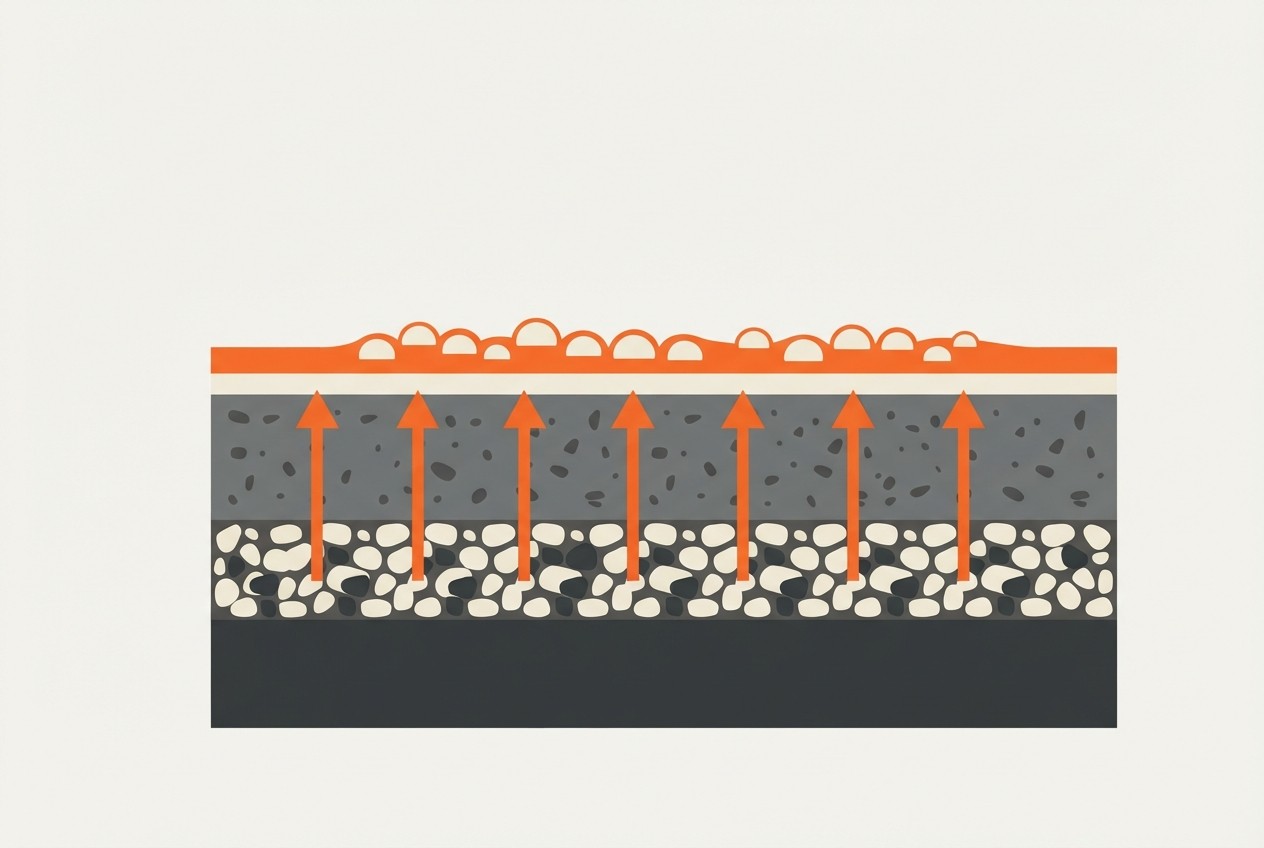
Most homeowners picture concrete as solid and dry. It is neither. Concrete is porous, and a slab poured on soil is in constant contact with the moisture in the ground beneath it. Water vapour moves up through the slab all year, usually slowly enough that you never notice, because it evaporates from the surface as fast as it arrives.
Put a coating on top and the evaporation stops. The moisture keeps arriving, collects under the film, and pushes. Weeks or months later the coating blisters, bubbles or lifts in sheets, and the homeowner assumes the product was defective. A fifteen-dollar test would have told them what was coming.
Read this if you are about to coat, seal or tile a garage slab and have not tested it for moisture. You can skip it if the slab is brand new and your coating supplier has already specified a test and a limit.
In this guide
Where the moisture comes from
Understanding the source tells you how serious a positive result is.
- No vapour barrier under the slab. Many older garage slabs were poured directly on soil or gravel with no plastic sheet beneath. Ground moisture passes straight up. A barrier cannot be added afterwards without removing the slab.
- A high water table or poor drainage. Heavy rain, a high water table or ground that slopes toward the garage can raise the amount of water the slab sits in.
- Hydrostatic pressure. In wet conditions, water in the soil can press upward against the slab with real force, which is much harder to manage than ordinary vapour.
- Moisture left in new concrete. A new slab holds a great deal of water from the pour and needs weeks to months to dry. Coating too early traps that water.
- Surface water. Wet vehicles, melting snow and pressure washing add water at the top. This is temporary, but it can confuse a test taken at the wrong time.
The simple plastic-sheet test
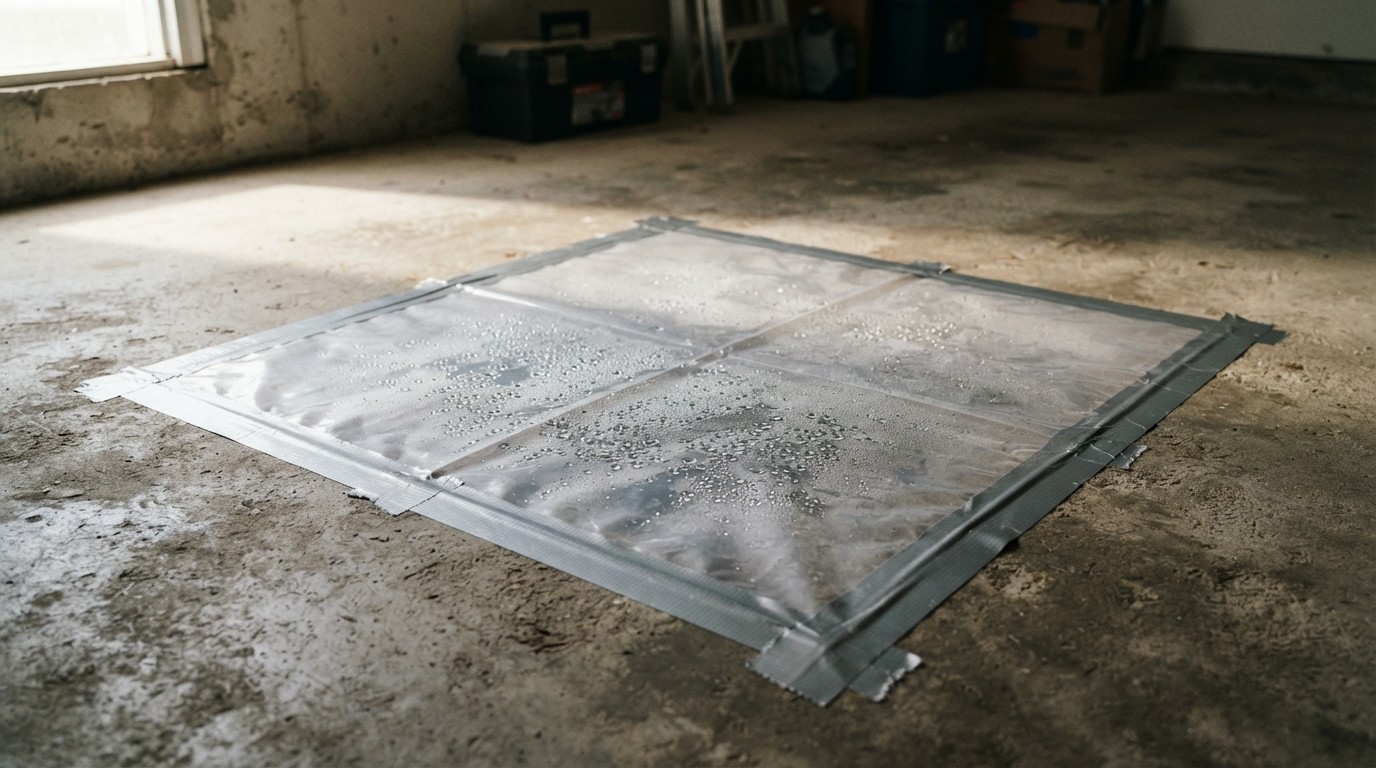
This is the basic field check described in the plastic sheet standard used across the industry, and it costs almost nothing. It tells you whether moisture is moving through the slab at the time you test. It does not tell you how much.
- Choose a dry period. Do not test right after rain, snow or a washdown, and make sure the surface is clean and dry.
- Cut a square of clear plastic sheeting, roughly two feet on a side. Clear is important, because you need to see underneath.
- Tape it down firmly on all four edges with strong tape so no air passes in or out.
- Leave it for about a day. Sixteen to twenty-four hours is the usual window, and longer is fine.
- Peel back one edge and look. Droplets or condensation on the underside of the plastic, or a visibly darker patch on the concrete, indicate that moisture is rising from the slab.
Two cautions about reading the result. A clean sheet does not prove the slab is dry, only that nothing visible moved in that spot over that period. And condensation can form on the sheet from the room’s own humidity if the sheet is not sealed well, so tape it properly.
Test more than one location. Use at least three: near an exterior wall, near the garage door, and in the middle. Moisture is rarely even across a slab, and the worst spot decides the outcome.
Quantitative tests
Coating manufacturers specify a maximum moisture level for their products, and the plastic-sheet test cannot tell you whether you are under it. Two standard tests produce numbers.
Calcium chloride test. A sealed dish of calcium chloride is placed under a dome on the clean slab for a set period, and its weight gain shows how much vapour the slab emitted. The result is a vapour emission rate. It is inexpensive, and a kit is available to buy, but it measures only the surface layer and can be affected by room conditions.
In-slab relative humidity testing. A probe is placed in a small hole drilled into the concrete and sealed, and after a stabilization period it reads the humidity inside the slab. This is considered more reliable than surface tests, because it measures the moisture condition deep in the concrete. It is usually performed by a professional with calibrated equipment.
The product’s technical data sheet states the limit it tolerates, expressed in whichever test the manufacturer uses. Find that sheet, find the limit, and compare. Do not rely on a general number from an article, including this one.
Other clues without any test
- White powdery deposits on the surface or along the base of the walls, called efflorescence, mean water is carrying minerals through the concrete and evaporating.
- Damp patches that appear and spread after rain.
- A musty smell, particularly after the garage has been closed up.
- Rust on the bottom of metal shelving, toolboxes or car jack legs that rest on the slab.
- Peeling paint at the base of the walls.
- Standing water or dampness that follows the slope of the yard toward the garage.
What a positive result means
A positive test is not the end of the project. It changes the approach.
- Slight moisture, within the product’s stated limit — Proceed, and use a primer or system that the manufacturer approves for the conditions.
- Moderate moisture, above standard limits — Use a moisture-mitigating primer system designed for the purpose, following its data sheet exactly.
- High moisture or suspected hydrostatic pressure — Do not coat. Fix the water source first, or choose floating tiles.
- Moisture only on one side of the garage — Investigate drainage, gutters and grading on that side.
- New slab, recently poured — Wait. Test again after more drying time before coating.
Moisture-mitigating primers are real products, and they work within their stated limits. They are also not a licence to ignore a serious water problem, and a coating system sold on the strength of its primer should still be checked against its own data sheet and a proper test.
Fixing the source, where you can
- Gutters and downspouts. Make sure roof water is delivered several feet away from the foundation rather than discharged beside it.
- Grading. Soil should slope away from the garage. A yard that slopes toward the slab concentrates water exactly where you do not want it.
- Garage door seal and apron. Water entering under the door adds to the problem and is usually inexpensive to correct.
- Humidity inside the garage. A dehumidifier in a closed garage lowers surface moisture, though it will not stop vapour rising through the slab.
If water is entering the garage, if the slab is heaving or cracking, or if the foundation seems to be involved, that is a question for a waterproofing contractor or a structural engineer, not for a coating guide.
Putting it together
Test before you buy materials, test in several places, and test when the slab is at its driest. Read the coating manufacturer’s moisture limit and compare it with your result. If the slab fails, you have saved yourself a peeled floor and a weekend of grinding it off, and you have a decision to make: fix the water, use a system designed for the conditions, or lay a floating floor instead.
What to do this weekend
- Tape three clear plastic squares to the slab: near an exterior wall, near the door and in the middle.
- Check them after a day and note which show condensation or darkening.
- Read the moisture limit on the coating’s data sheet before you buy a single litre.