A finished floor makes the rest of a garage look like unfinished business. Once the slab is sorted, the clutter along the walls becomes the obvious problem, and the storage aisle at the hardware store offers a bewildering set of options: track panels, slatwall, pegboard, steel cabinets, overhead racks, ceiling hoists.
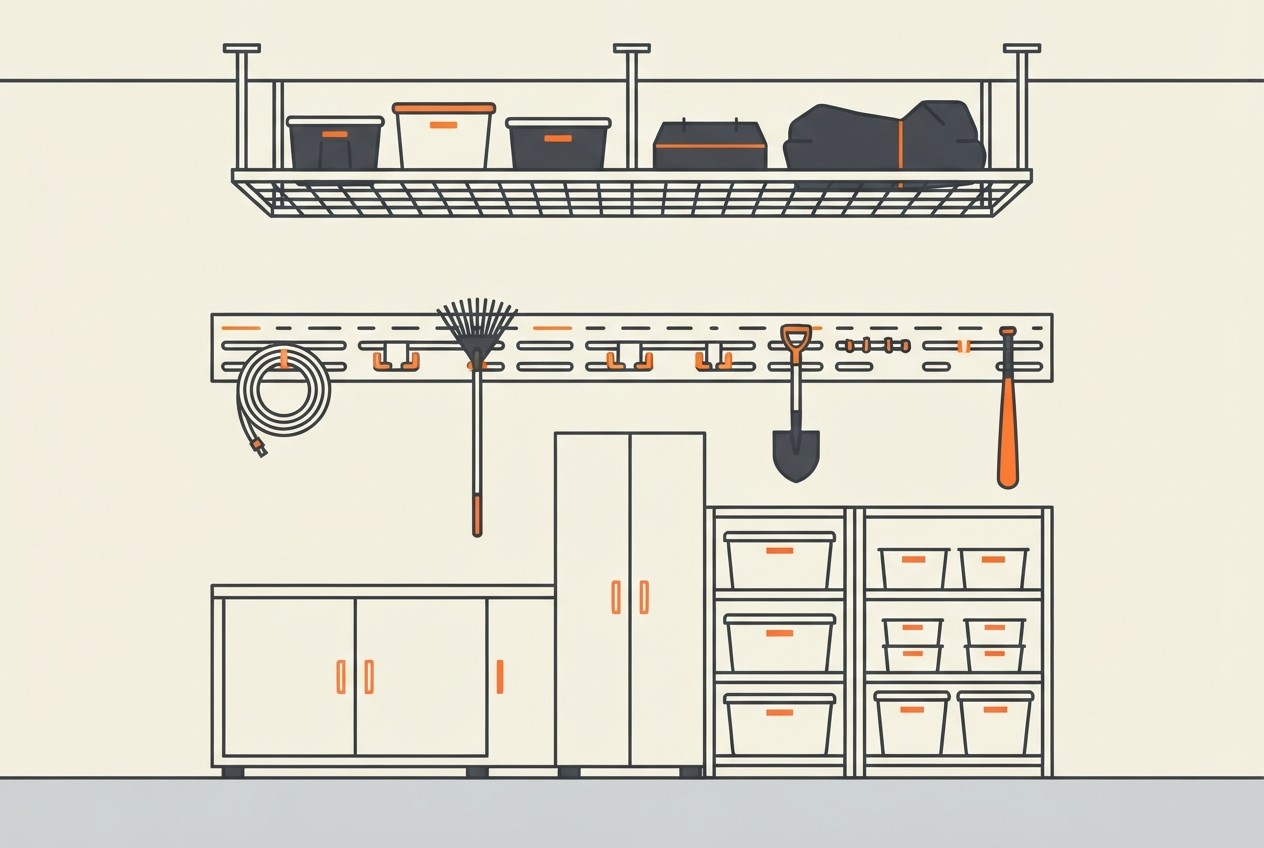
The way to cut through it is to stop thinking about products and start thinking about zones. Every garage has three, and each suits a different kind of storage.
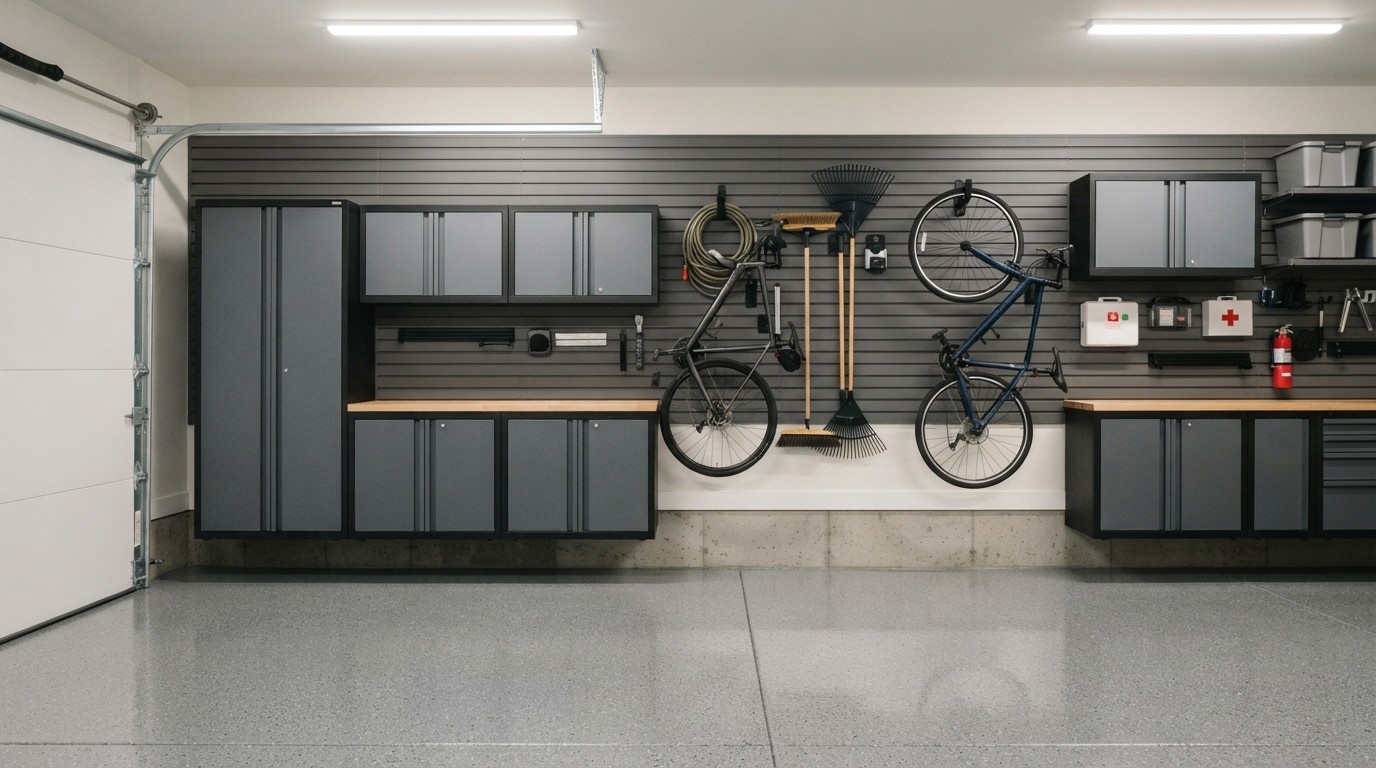
Short answer: plan storage in three zones: rarely used items overhead, everyday items at eye level, heavy things on the floor. Fix everything into studs or masonry, respect the stated ratings, and leave room to open the car doors.
In this guide
The three zones
Overhead is the space above head height, including the ceiling above the parking bays. It suits bulky, light, rarely used items: seasonal decorations, camping gear, luggage, spare bedding. You want to reach them twice a year.
Eye level, roughly between knee and shoulder height on the walls, is the prime real estate. It holds anything you use weekly: hand tools, garden tools, sports equipment, cleaning supplies, everyday paint. Put the most-used items here, within easy reach.
Floor level is for heavy, bulky and rolling things: the tool chest, bins of heavy items, the lawn mower, the wet-dry vacuum, bags of soil. Their weight is carried by the floor, not the wall.
Wall track and slatwall
Rail systems attach horizontally to the wall and accept an assortment of hooks, shelves and bins that can be moved around. Slatwall is the panel version of the same idea. Their strength is flexibility: you can rearrange as the contents change.
Good for: garden tools, ladders, bicycles, hoses, sports gear, and any collection that changes over time.
Watch for: the weight rating. Each accessory has its own stated limit, and so does the track. These ratings assume the track is fixed into wall studs or masonry with the fasteners specified. Mounting into drywall alone, or using the wrong anchor, is the common way systems fail.
Pegboard
Inexpensive and easy to install, perforated hardboard or metal pegboard takes lightweight hooks and holders. It is excellent for small hand tools where you want everything visible at a glance.
It is not built for heavy loads, and hardboard sags if overloaded. It suits a workbench wall better than a general storage wall.
Cabinets
Closed cabinets hide clutter, keep dust and moisture off contents, and can be locked. Steel and heavy-duty polymer cabinets are common, and either can handle a garage’s temperature swings better than particleboard, which swells if the garage is damp.
Cabinets are where to keep chemicals, paints and anything you want out of reach of children. Store them in line with the instructions on their labels, which commonly address temperature limits and ventilation, and with any local rules on storing flammable materials.
Floor-standing cabinets rest on levelling feet, and the floor beneath them matters. If you are coating or tiling the floor, do it first and let it cure fully before cabinets go on, so you are not working around them. Check the coating manufacturer’s guidance on when heavy items can be placed.
Overhead racks and ceiling hoists
Ceiling-mounted racks use the otherwise wasted space above the parking bays. They are the best answer for bulky, light, seasonal items, and a hoist-style system can lower a kayak or a roof box to waist height.
They also involve the most risk, because the load is above your head and the structure carrying it is the ceiling. Manufacturers state the weight each rack can hold when attached to specified structure, such as ceiling joists, at specified spacing and with specified fasteners. Garage ceilings are often built with lightweight trusses or finished with thin drywall, neither of which is designed to carry a heavy load.
Follow the manufacturer’s installation requirements exactly, never exceed the stated rating, and if you are unsure what your ceiling framing is or what it can carry, ask a qualified professional before you drill. A rack that detaches is a real hazard, and it is not something to improvise.
Which system does what
- Wall track or slatwall. Best zone: Eye level. Strength: Reconfigurable, many accessories. Limit: Needs stud or masonry fixing; per-accessory weight limits.
- Pegboard. Best zone: Eye level, workbench. Strength: Cheap, shows everything. Limit: Light loads only.
- Cabinets. Best zone: Floor level, eye level. Strength: Hidden, dust-proof, lockable. Limit: Less flexible; take floor space.
- Open shelving. Best zone: Floor level. Strength: Affordable, holds bins. Limit: Dusty; look cluttered when messy.
- Overhead racks. Best zone: Overhead. Strength: Uses unused space. Limit: Depends entirely on ceiling structure and installation.
- Hoist systems. Best zone: Overhead. Strength: Lowers bulky items to reach. Limit: Highest load and installation demands.
Planning the layout
- Empty and sort first. Sort into keep, relocate and discard. Many garages are two-thirds full of things that should not be there, and no storage system fixes that.
- Measure the car. Park each vehicle and mark the space needed to open doors fully. Storage that blocks a car door is storage you will end up removing.
- Group by activity. Gardening together, car care together, sports together. You should be able to pick up everything for a task from one place.
- Start with the heavy items. Place the tool chest, mower and large bins first, then plan walls around them.
- Mark studs before buying. A stud finder and a pencil tell you where fixings can go and prevent a system being bought that does not fit your wall.
- Leave a clear path. Walking from the car to the door with arms full should not involve turning sideways.
- Plan for growth. Leave around a fifth of the space empty. Garages fill to whatever capacity they are given.
Things worth keeping off the floor
Raising stored items a few inches off the slab protects them from damp, from spills and from the occasional flood. Cardboard boxes in particular wick moisture from a concrete floor and fail within a season. Plastic bins on shelves or on low pallets last far longer, and they help a floor coating too, because trapped moisture and dragged boxes are hard on it.
The best storage system is the one you will actually put things back into. Pick the simplest arrangement that handles your three zones, mount it into solid structure, respect every stated weight rating, and keep the floor clear. A garage organised around how you actually use it stays tidy far longer than one organised around what looked good on the packaging.
Takeaways
- Zones beat products: decide what lives where before you buy anything.
- Every rating assumes correct fixing into solid structure with the specified fasteners.
- Keep stored items off the slab, and leave about a fifth of the space empty for growth.
Finished the storage and still have a tired floor? Read our guide to choosing a garage floor coating before the cabinets go in.