Ask a flooring professional what separates a garage floor that lasts from one that peels, and the answer is rarely the coating. It is what happened to the concrete beforehand. Surface preparation is the least photogenic part of the job, the part that takes the most time, and the part most often compressed by people who just want to see the colour go on.
The central choice in preparation is between grinding the slab mechanically and etching it with an acid solution. The kits sold with most consumer coatings include an etching product. Professionals overwhelmingly grind. Here is why.
Picture a homeowner who rolls out a coating on a Saturday and watches it lift under the first warm tire in June. The coating was fine. The slab was glazed with a smooth, weak skin that nothing could grip, and an etching wash had barely touched it.
In this guide
What a coating needs from the concrete
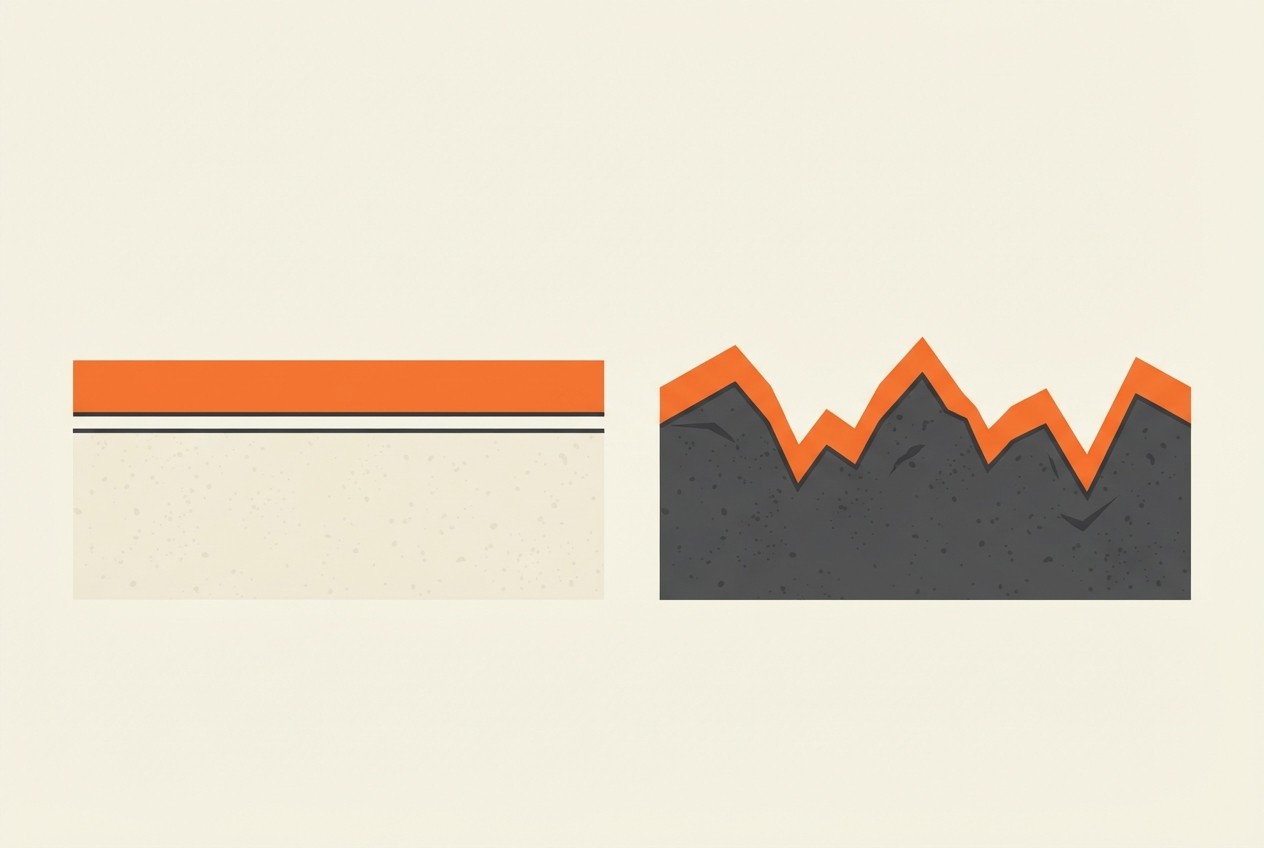
A coating does not stick to concrete the way tape sticks to glass. It grips mechanically, flowing into the microscopic peaks and valleys of an open, slightly rough surface and hardening there. Concrete that is smooth, sealed, or covered with a weak surface layer gives it nothing to hold.
Troweled concrete, which is how most garage slabs are finished, is the problem case. The finishing process brings fine cement paste to the top and polishes it into a dense, smooth skin called laitance. Laitance is weak, and a coating bonded to it is only as strong as that skin. Preparation has to remove it and open the surface underneath.
The coating industry describes the target as a surface profile. Trade bodies publish a numbered scale that rates how rough a prepared surface is, and manufacturers state which profile their product needs. Thin coatings want a fine profile; thick, high-build systems want a rougher one. The point for a homeowner is that preparation is measured against the product’s requirements, not against how clean the floor looks.
Acid etching: why it disappoints
Etching applies an acid solution that reacts with the cement paste and roughens the surface slightly. It is cheap, needs no special machine, and can be done with a watering can and a broom. It is also the reason so many do-it-yourself floors fail.
- The profile is shallow and uneven. Acid works faster on some areas than others, producing patchy results that depend on how the solution happened to pool.
- It does not remove contamination. Oil, grease, previous sealers and curing compounds sit in or on the surface. Acid does not dissolve most of them, and a coating applied over them peels in those spots.
- It leaves residue. Reaction products must be thoroughly rinsed and neutralized, and any left behind interfere with bonding. Rinsing also introduces a large amount of water into a slab that must then dry completely.
- It adds moisture. A wet slab is the opposite of what a coating wants, and drying times are easy to underestimate.
- The chemicals themselves are hazardous. Acid products carry serious handling warnings. Read and follow the manufacturer’s safety data sheet.
Etching can be acceptable on a new, clean, unsealed slab with a very thin product, and some manufacturers still specify it for particular systems. But it is the weakest of the preparation options, and it is a poor match for the thicker, more durable coatings people increasingly want.
Diamond grinding: what it does differently
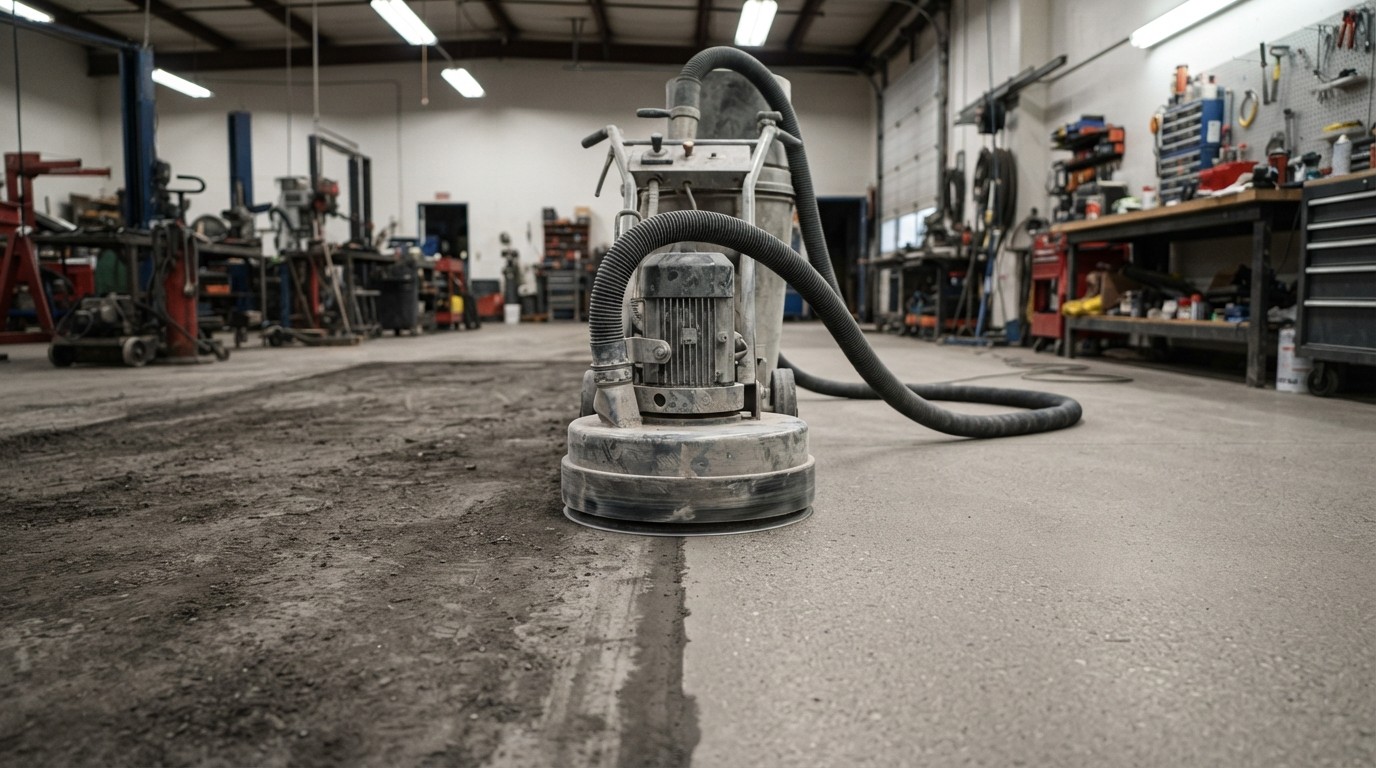
A grinder is a machine with a rotating plate fitted with diamond-impregnated segments. It physically abrades the top of the slab, removing laitance, previous coatings and surface contamination, and exposing clean, open concrete. By choosing the grit of the diamond tooling, the operator controls how coarse a profile results.
The result is consistent across the whole floor, independent of how liquids happened to flow. It works on slabs that are sealed or previously coated, where acid does nothing. And it leaves the surface dry, because it uses no water.
The dust is a real issue
Grinding concrete creates fine dust, and concrete dust can contain crystalline silica, which is recognized as a respiratory hazard. This is why serious grinding is done with a shrouded machine connected to a dust extractor, not with an open grinder and a broom.
It is also a reason to think carefully about doing the work yourself. Dust control, appropriate protective equipment and equipment handling are governed by manufacturer instructions and, for contractors, by workplace safety rules. We do not give exposure advice here. If you rent a grinder, follow the rental company’s instructions exactly, and if the safety requirements seem like more than you want to take on, that is a legitimate reason to hire it out.
Judging your slab before you decide
Before choosing a method, spend twenty minutes reading the floor.
- The water-drop test. Sprinkle a little water in several spots. If it soaks in within a minute or two, the surface is open and absorbent. If it beads, the slab is sealed or contaminated, and etching will not work.
- Look for stains. Dark oil patches are the common contaminant. Oil that has soaked deeply may need degreasing and multiple passes, and in bad cases it can keep working its way back to the surface.
- Check for an existing coating. Paint, an old sealer or a failed coating has to be removed completely. Grinding is the realistic way to do it.
- Check the surface by hand. Scrape a spot with a screwdriver. If the surface powders or flakes, it is weak and has to come off. Dusting concrete needs to be ground back to sound material.
- Map cracks and joints. Hairline cracks are routinely filled with appropriate repair material before coating. Cracks that are wide, offset, or growing can indicate movement, and those belong to a structural professional rather than to a filler cartridge.
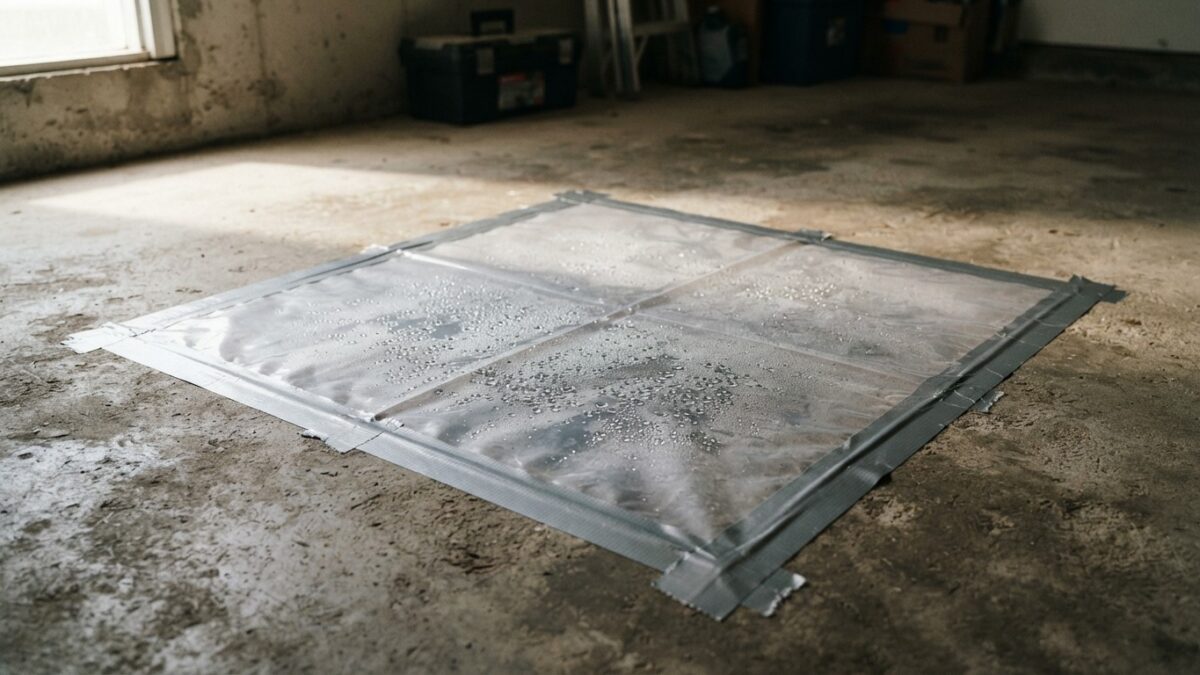
- Test for moisture. Preparation does nothing if water is rising through the slab. See our guide to testing a slab for moisture before you spend anything on materials.
Etching and grinding, point by point
- Surface profile. Acid etching: Shallow, inconsistent. Diamond grinding: Controlled by tooling.
- Removes old sealers and coatings. Acid etching: No. Diamond grinding: Yes.
- Handles oil contamination. Acid etching: Poorly. Diamond grinding: Better, with degreasing first.
- Adds water to the slab. Acid etching: Yes, significantly. Diamond grinding: No.
- Equipment needed. Acid etching: Basic tools. Diamond grinding: Shrouded grinder and dust extractor.
- Main hazard. Acid etching: Chemical handling. Diamond grinding: Dust and machine handling.
- Suitability for durable coatings. Acid etching: Limited. Diamond grinding: Preferred.
The details that decide the result
Edges and corners. A floor grinder cannot reach tight to walls. The perimeter, usually several inches wide, needs a hand-held grinder or it becomes the first place the coating lifts. Skipping the edges is the single most common shortcut.
Vacuum thoroughly afterwards. Residual dust prevents bonding. A dust extractor handles most of it during grinding, but a final pass with a proper vacuum, not a broom, is routine before any material is mixed.
Treat control joints deliberately. The saw cuts that divide a slab are placed to allow controlled cracking. Filling and coating over them as if they were solid concrete can lead to the coating cracking along the line. Manufacturers give guidance, and installers commonly follow the joint rather than bridging it.
Allow time. A two-car garage can take most of a day to grind, clean, repair and let the repairs cure, before any coating goes on. A schedule that assumes the whole job fits in a weekend usually means preparation is where time was saved.
Doing it yourself, or hiring it
Grinding is physically demanding, noisy and dusty, and doing it well takes some practice with the machine. Many homeowners sensibly split the job: hire a professional to prepare and coat, or hire someone only for the grinding and apply a forgiving product themselves.
If you do choose to etch, treat it as a minimum rather than a norm. Confirm that the coating manufacturer actually accepts etching for the system you are using, follow the product’s instructions and safety data sheet exactly, and rinse and dry the slab with more patience than the box suggests. Then test for moisture again before you open any coating.
The best coating on a poorly prepared floor will lose to a modest coating on a well-prepared one, every time. Spend the effort where the failures begin.
Myths worth retiring
Myth: Etching is just a cheaper version of grinding.
Reality: They do different jobs. Etching dissolves a thin layer of cement paste and cannot remove sealers or oil. Grinding removes the weak surface layer itself.
Myth: If the floor looks clean, it is ready.
Reality: Invisible contamination and old sealers are what coatings fail over. The water-drop test tells you more than your eyes do.
Myth: A thicker coating can make up for poor preparation.
Reality: Thickness adds weight, not grip. A heavy film on a weak surface simply peels in bigger sheets.